Dedicated to the definitive superhero non-team.


Showing posts with label Avengers. Show all posts

Monday, November 2, 2026

The Old Order

I had read the Avengers on and off for about two years before picking up #210. In that issue, Earth's mightiest heroes split up across the globe to battle the powerful Weathermen: Beast went to Buenos Aires; Scarlet Witch and Vision went to Kansas; Wasp and Wonder Man went to Antarctica; Captain American and Iron Man went to London; Thor remained in New York. Only after the others left did Thor encounter the robot Jocasta, who still lived at Avengers Mansion yet somehow was overlooked. I very much liked this combination of Avengers and was disappointed when #211 reorganized the lineup.

Avengers. Vol. 1. No. 210. August 1981. "You Don't Need the Weathermen to Know Which Way the Wind Blows!" Bill Mantlo (writer), Gene Colan (artist), Dan Green (inker), Jean Simek (letterer), Ben Sean (colorist), Jim Salicrup (editor), Jim Shooter (editor-in-chief).

Sunday, May 25, 2025

Some Enchanted Evening

Dazzler #2 felt like it should have included the Defenders. Jealous of her musical success, the evil Enchantress decided to sabbotage one of Dazzler's performances not only by attacking the singer/heroine but also by unleashing a horde of demons. The audience that night happened to include Spider-Man, along with members of the Fantastic Four, X-Men, and Avengers. Although the heroes prevailed, the mystical nature of the threat would have been right up the Defenders' alley.

Even at this early stage in her career, Dazzler was already thinking of getting rid of her signature blue makeup, which she described as a gimmick. She stopped wearing stage makeup altogether by the time of the Beauty and the Beast limited series.

Dazzler. Vol. 1. No. 2. April 1981. "Where Demons Fear to Dwell!" Tom DeFalco (writer), John Romita, Jr. (penciler), Alfredo Alcala (inker), K. Klaczak (colorist), Jim Novak (letterer), Louise Jones (editor), Jim Shooter (editor-in-chief).

Friday, November 8, 2024

Announcing Aragorn!

The Black Knight began riding his winged stallion in Avengers #48, but not until #54 did he settle on the name Aragorn. The hero would shout, "Away, Aragorn!" or "Down, Aragorn!" when commanding the horse to fly or land.

The Black Knight and Aragorn faced the Masters of Evil in Avengers #54 (July 1968).

Friday, October 25, 2024

The Origin of Aragorn

Technically speaking, Aragorn made his debut in Avengers #48 (Jan. 1968). In that issue, however, the Black Knight called the winged horse Pegasus. Not until later appearances was the horse renamed Aragorn. The name change made sense, as Aragorn had no relation to the flying horse from Greek mythology. In fact, the Black Knight described his winged stallion as a mutant. The mutation was not accidental but instead resulted from months of research.

Aragorn was in good company. When the original X-Men encountered a technological wizard called the Warlock, he too described his winged horses as mutants—the products of science rather than magic X-Men #30 (March 1967).

This image of the Black Knight riding Pegasus (Aragorn) comes from Avengers #48.

Wednesday, September 18, 2024

X-Men vs. Defender

The original X-Men faced an unexpected enemy when the Puppet Master took mental control of Mimic, who could replicate the heroes' mutant powers. Guarding the Puppet Master's criminal lair was a formidable android called the Defender (X-Men #27).

To prepare for a looming mutant menace, Professor X invited Scarlet Witch and Quicksilver to join the X-Men. They declined. The siblings had previously discussed that possibility but became Avengers instead (Avengers #16). Quicksilver, in particular, wanted to distance himself from any reminder of their early days in the Brotherhood of Evil Mutants.

These panels with the android Defender come from X-Men #27 (Dec. 1966).

Thursday, April 25, 2024

Defenders Dialogue: Non-Team

Defenders #21 (March 1975) included this letter contrasting the Defenders to Marvel's other superhero teams. For context, the original X-Men were appearing in reprints at the time; their series would revitalize with an "all-new, all-different" team of mutants starting with X-Men #94 (August 1975).

Dear Marvel,

With their new official headquarters, the Defenders seem to be slowly edging toward becoming a real team instead of a non-team. This should not be done.

What makes each Marvel superhero group individual is its form of organization. The Fantastic Four is a family, and with all its supporting characters it almost takes on the form of a tribe. The Avengers is a democratic body. The X-Men, of course, are organized as a school, so they never quite gained the respectability of the F.F. or the Avengers. There is nothing more respectable than family and democracy, but students don't really belong to polite society.

But the Defenders are anarchistic. They don't even exist as far as society is concerned. They should stay as loose and anarchistic as possible to retain their distinctness from the other Marvel groups.

Jana C. Hollingsworth
Port Angeles, Wash.

Friday, May 19, 2023

Chaotic Evil: Brain-Child

The Squadron Supreme's homeworld was on the brink of destruction. Arnold Sutton, a superhuman ten-year-old dubbed Brain-Child, invented a device that would cause the sun to go super-nova (Avengers #86). Such nihilistic plans had all the trappings of Chaotic Evil from the nine-alignment system of Dungeons & Dragons.

During a team-up with the Avengers, Dr. Spectrum of the Squadron ultimately saved the day by using his Power Prism to change Arnold into an ordinary boy—with no memory of his previous intentions to destroy the world. We can only speculate whether this change to the brain had a lasting effect on Arnold's alignment.

  Lawful Good    Neutral Good    Chaotic Good  
  Lawful Neutral    True Neutral    Chaotic Neutral  
  Lawful Evil    Neutral Evil    Chaotic Evil  

Friday, October 21, 2022

The Best of All Possible Worlds

Defenders: Beyond #4 explored a version of reality where Blue Marvel prevented the assassination of John F. Kennedy and Galactus was the "life-Bringer" rather than a devourer or worlds. The utopia wasn't all it was chalked up to be, however. Tigra, for example, was now the trusted leader of the Avengers, which amounted to Earth's mightiest heroes asking her to watch their belongings or run errands. Ultimately, the Defenders sought to escape this superficially idyllic realm and return to the world they knew.

Defenders: Beyond. Vol. 1. No. 1. December 2022. "The Land of Couldn't-Be-Shouldn't -Be." Al Ewing • Javier Rodríguez • VC's Joe Caramagna • Wil Moss • Michelle Marchese.

Sunday, July 10, 2022

Superheroes Sinister

When the story from Defenders #13 (May 1974) later ran in Rampage #12 (Jan. 4, 1976), the U.K. reprint series kept the cover illustration of the original. But whereas the original cover text promoted Super-Team vs. Super-Team, the reprint said, "Superheroes battle Superheroes when--the Squadron Sinister Strikes!

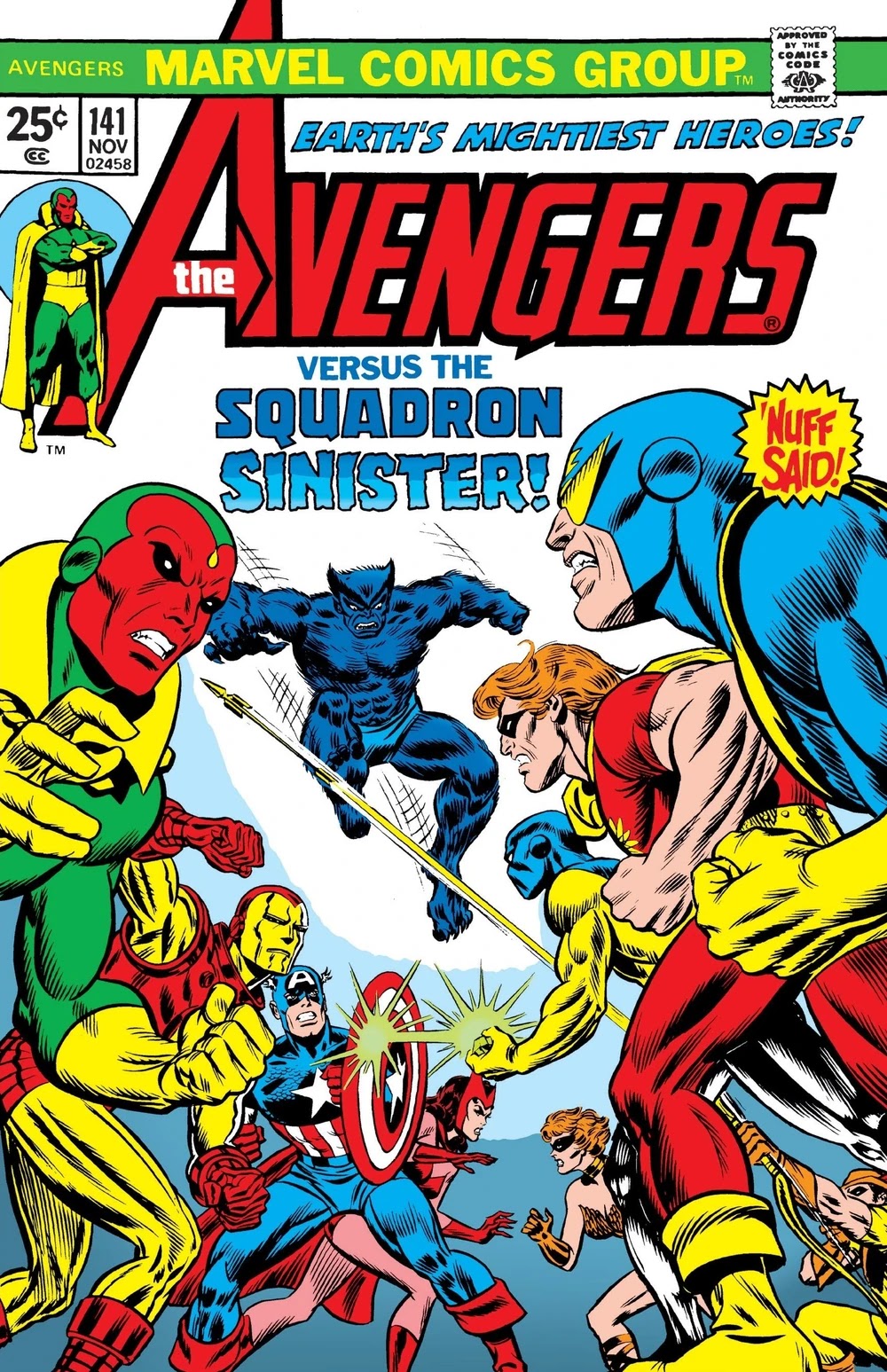
As their name implied, of course, the Squadron Sinister were not superheroes. To be fair, though, the Squadron Sinister did look strikingly like their superheroic counterparts in the Squadron Supreme—so much so that the cover of Avengers #141 (Nov. 1975) had incorrectly billed the Squadron Supreme as the Squadron Sinister!


Saturday, March 26, 2022

In Summary

Published weekly in the United Kingdom, the series Rampage reprinted early issues of the Defenders. With the covers promising a complete Defenders story each issue, the series took a novel approach to the multi-part Avengers-Defenders War. Instead of reprinting the historic event over the course of several issues, Rampage #10 (Dec. 21, 1977) summarized the events from Avengers #115-118/Defenders #8-10 as two pages of background text and then reprinted Defenders #11 (Dec. 1973), the closing chapter of the crossover.

On the cover of Rampage #10, Dr. Strange refers to his teammates as comrades. When the word balloon originally appeared on the cover of Defenders #11, he called them Defenders.

Friday, March 11, 2022

The Case for Mantis

After much anticipation, Mantis became the Celestial Madonna because she had learned humility whereas Moondragon had not. What evidence worked in Mantis' favor? On a superficial level, Mantis seldom used the word I, typically referring to herself instead as "this one" (and, as a result, the first time I read a comic book featuring Mantis, I thought she was speaking of another character).

While giving lip service to a form of detachment, Mantis was not without flaw. Unhappy in her relationship with the Swordsman, Mantis made romantic overtures toward Vision by saying that others suitors were unworthy (Avengers #128). Already in love with the Scarlet Witch, Vision rebuffed such advances. When Mantis came to regret her behavior, Vision gladly accepted her apology (#131). Ultimately, Mantis' willingness to acknowledge when she was mistaken gave her an edge over Moondragon.

Mantis joined the Avengers in #114 (Aug. 1973). As the Celestial Madonna, she married an intelligent plant that took on the physical appearance of the Swordsman.

Sunday, June 27, 2021

Boy with a Gun

The cover of Avengers #218 was particularly disturbing, with a boy pointing a gun to his head. Having arrived at Avengers Mansion seeking help, the boy could not convince the heroes to take him seriously until he pulled out a gun and shot himself. Iron Man, Thor, Captain America, and Wasp were beside themselves as they witnessed the boy's body disintegrate … only to return to life within minutes.

The boy claimed to be a reincarnation of Morgan MacNeil Hardy, an inventor who had died of mental backlash resulting from his Psi-Augmentor (Captain America #264). The boy explained that he had lived numerous lifetimes, always returning to life as a child after he died. In the past, he would have no memory of his earlier incarnations. Because of the Psi-Augmentor, however, the boy now retained the anguished memories of Morgan MacNeil Hardy and knowledge of his perpetual existence.

Desperately wanting to end this cycle, the boy snuck aboard a scientific probe headed to the Sun. Instead of permanently dying, the boy mutated into a plasma monster and returned to Earth. Defeated by the Avengers, the creature exploded into nothingness, then regrew to a boy—seemingly unburdened by the knowledge of his past selves.

A flashback to Captain America #264 showed the four telepaths who initially tested Morgan MacNeil Hardy's Psi-Augmentor. Two of them died from the mental backlash. The survivors, Ursula Richards and Philip Le Guin, were two of the six telepaths who would subdue Over-Mind.

Avengers. Vol. 1. No. 218. April 1982. "Born Again (and Again and Again…) J.M. DeMatteis (scripter/co-plotter), Don Perlin (layouts), Joe Rosen (letterer), Christie Scheele (colorist), Jim Salicrup (editor), Jim Shooter (co-plotter/editor-in-chief).

Tuesday, March 2, 2021

What if ... Thor Had Joined the Defenders?

Today's blog post takes inspiration from Marvel's classic series that asked, "What if…?" In that vein, I consider how a key decision in the formation of the Defenders might have unfolded differently.

On that fateful day when Dr. Strange formed the Defenders (Marvel Feature #1), Prince Namor was his first recruit. In need of a second ally with great physical strength, the sorcerer reluctantly selected the Hulk. Dr. Strange summoned the green goliath only because Silver Surfer was trapped on Earth and couldn't travel with them to another dimension, and because Dr. Strange presumed that Thor was unavailable. But what if Dr. Strange hadn't jumped to that conclusion? And what if Thor was indeed available? In other words, What if … Thor had joined the Defenders?

In this speculative timeline, Dr. Strange, Namor, and Thor would found the non-team. During their early adventures, the thunder god would prove as capable a Defender as the Hulk had been in the original published stories.

Without the Hulk, however, the events from Defenders #7 would play out differently. In the original story, Hawkeye tried to capture the Hulk and then accepted Valkyrie's offer to join the Defenders. (Valkyrie herself joined in Defenders #4.) Yet if Hulk had no ties to the Defenders, Hawkeye would not have met the non-team at that time, much less join them.

This change in lineup would affect the crossover event spanning Defenders #8-11; Avengers #115-118, when the two teams clashed. As originally published, Thor of the Avengers battled Hulk of the Defenders, while Iron Man of the Avengers squared off against Hawkeye of the Defenders. In this alternate version, Thor of the Defenders would battle Iron Man of the Avengers. In both versions, the teams would put their differences aside at the end of the story. Not everything would balance out so evenly, however.

Nighthawk's membership into the Defenders (#13-14) would inevitably lead the non-team to meet Power Man and then battle the Wrecking Crew (#17-19). Here, fate would change irrevocably. The original story required Hulk to return to his alter ego as Bruce Banner and save the day by deactivating a dangerous Gamma Bomb. Unlike Banner, Thor's alter ego of Donald Blake was a physician, not a physicist. Without Bruce Banner's know-how, the Gamma Bomb would detonate and kill 20 million people. As a result, this story would end in tragedy, just like many tales published in the series What If…?

This panel with Dr. Strange and Bruce Banner comes from Defenders #19.

Sunday, November 1, 2020

The Secret Origin of Dr. Druid

As Dr. Druid grew in prominence, the similarities between his origin story and the origin of Dr. Strange became hard to overlook. Avengers Spotlight #37 reconciled this coincidence while reinvigorating the character.

Within the issue, Dr. Druid learned that the lama who had sent for and trained him in the Himalayas some time ago was none other than the Ancient One who went on to train Dr. Strange. The world needed a magical protector before Dr. Strange was psychologically ready to learn the mystic arts, so the Ancient One selected Dr. Druid as a precursor to Dr. Strange—cultivating the powers of the ancient Britons that Dr. Druid inherited.

With this revelation, Dr. Druid felt repentant for his manipulative behavior as a member of the Avengers. Further, he underwent a physical transformation, appearing as he might have looked a few years before his initial meeting with the lama (a.k.a. the Ancient One). Dr. Druid retained this younger body, with a full head of hair, during his time with the Secret Defenders.

Avengers Spotlight. Vol. 1. No. 37. October 1990. "Interlude in a Peaceable Kingdom!" Roy & Dann Thomas (writers), Bob Hall (penciler), Win Mortimer (inker), Rick Parker (letterer), R. Witterstaetter (colorist), Mark Gruenwald (editor), Tom DeFalco (editor in chief).

Saturday, September 19, 2020

Double Disguise

Avengers #119 (Jan. 1974) continued a comic book tradition of acknowledging the real-life Rutland Halloween Parade, where residents of the Vermont town celebrate in superhero attire. For several years in a row, Marvel Comics depicted parade organizer Tom Fagan dressed as Nighthawk, an ironic decision since Nighthawk was still a villain at the time.

Within the comic book, the devious Collector capitalized on this situation during Rutland's Fourteenth Annual Halloween Parade by wearing a Nighthawk costume to disguise himself as Tom Fagan. Anticipating that the Avengers would attend the festivities, as they had in the past, the Collector laid a trap to capture the heroes.

On a serendipitous note, the actual Nighthawk (Kyle Richmond) would soon reform from his criminal ways in Defenders #13 (May 1974) and redesign his costume as a hero.

Avengers. Vol. 1. No. 119. January 1974. "Night of the Collector." Steve Englehart (author), Bob Brown (artist), Don Heck (inker), Artie Simek (letterer), Glynis Wein (colorist), Roy Thomas (editor).

Saturday, March 28, 2020

Shuffling the Deck

Tarot #4 wrapped up the dimension-crossing limited series by centering on a band of heroes who were creative hybrids of longstanding members of the Avengers or Defenders. Leading the unnamed team was Major Gamma, a version of Captain America with green skin resulting from exposure to Gamma radiation (like the Hulk).

Perhaps the most imaginative character in the new group was Doc Surf, a trippy take on Doctor Strange, equipped with a supernatural surfboard (resembling the model flown by Silver Surfer).

Another notable member of the team was Imperius Hex (the Latin term Imperius Rex with an allusion to the hex powers of Scarlet Witch). With trident in hand and emblem on his bare chest, this mystical counterpart to Sub-Mariner had a striking resemblance to classic appearance of Daimon Hellstrom, the Son of Satan.

The hybrid characters remained rather one-dimensional, though, as they soon restored the metaphysical breech that had brought them into existence and was wrecking havoc across the multi-universe.

Sunday, March 22, 2020

Disregarding the Defenders

Avengers #137 is perhaps best known as the issue when Beast and Moondragon joined the team, long before their involvement with the Defenders. Wasp returned to active Avengers duty in #137, as well, bringing husband Yellowjacket along for the ride.

Wasp bemoaned how her "bullheaded better-half" had left her behind while adventuring in Giant-Size Defenders #4. Upon his return, Yellowjacket explained to his Avengers teammates how he wasn't "let go" from the Defenders, as the non-team lets heroes come and go as they please. Hawkeye, who had already returned to Avengers status after a stint with the Defenders, dismissed the non-team as "that crazy crew--"

Avengers. Vol. 1. No. 137. July 1975. "We Do Seek Out New Avengers!!" Steve Englehart (saga), George Tuska (art), Vince Colletta (embellishment), C. Jetter (lettering), P. Rachelson (coloring), Len Wein (editor).

Thursday, January 2, 2020

Turning to Tarot

Since the time I started this blog twelve years ago, I've witnessed numerous attempts to revamp the Defenders. None impressed me as much as Tarot #1.

Bringing together Hulk, Namor, Valkyrie, Silver Surfer, and Dr. Strange, the mini-series features five of the earliest and most iconic members of the original non-team … with a seasoned sense of camaraderie.

The premiere issue found the heroes facing Cyrus Black, one of the team's oldest foes. Within the story, Namor remembered a surprising moment in 1944 when Captain America turned into a green-skinned Hulk. A visit to Avengers Mansion, however, found that Captain America had no memory of this dubious event.

Pual Renaud illustrated this variant cover of Tarot #1 (March 2020). Alan Davis wrote this issue.

Monday, December 30, 2019

Signaling Sunfire

Numerous skirmishes filled the pages of Defenders #8-11 and Avengers #115-118, as members of both teams fought over an artifact known as the Evil Eye.

My favorite chapter in the multi-part drama came in Avengers #117 (Nov. 1973), when Sub-Mariner and Captain America battled on the coast of Japan. The setting made a fitting backdrop to remind readers how the the two heroes had been allies during World War II.

The modern-day conflict became all the more heated with the surprise appearance of Sunfire. The patriotic hero warned Sub-Mariner and Captain America to take their feud away from Japanese shores. While acting as both outsider and antagonist, Sunfire was symbolic in numerous ways:

  • Like Captain America, Sunfire wore his nation's flag as a costume, drawing attention to the world at large.
  • Sunfire's flame powers contrasted with Sub-Mariner's water-breathing … and were reminiscent of the original Human Torch who had teamed up with Cap and Subby during the Golden Age of comics.
  • Having first appeared in X-Men #64 (Jan. 1970), Sunfire's presence in the midst of the Avengers/Defenders War furthered the presence of mutants at a time when only reprints appeared the pages of the X-Men (#67-93).

In other words, Sunfire was the perfect guest star for Avengers #117.

Monday, October 28, 2019

The Making of a Witch

Though her "hex power" could defy the laws of physics, there was nothing inherently supernatural about the Scarlet Witch or her mutant ability to alter probability. At least not at first.

That changed in Avengers #128 when renowned witch Agatha Harkness offered to help Scarlet Witch better control her power through the study of witchcraft.

Having recently been the target of a mystical attack, Miss Harkness (as Scarlet Witch called her) recited this magical verse for privacy and protection within her new guest room inside Avengers Mansion.

Storm-clouds above us
And hellfire below--
May we here between you
Serenity know!
Dark powers of midnight--
Dark powers of day--
Envelop this chamber
And seal us away!

A moment later, the evil Necrodamus materialized within the room. A servant of the Undying Ones from Defenders #1-3, Necrodamus mystically stunned Agatha Harkness and her cat, Ebony. Alone against the intruder, Scarlet Witch used her hex power to open a magic box in Necrodamus' hands, unleashing a maelstrom of evil spirits that subsumed him.

Agatha Harkness trained Scarlet Witch until Giant-Size Avengers #4 (June 1975). The element of witchcraft gave more creative license to the character's unpredictable mutant power.

Avengers. Vol. 1. No. 128. October 1974. "Betwitched, Bothered, and Dead!" Steve Englehart (story & color), Sal Buscema (art), Joe Staton (embellishment), Tom Orzechowski (lettering), Roy Thomas (editor).