Showing posts with label music. Show all posts
Showing posts with label music. Show all posts
Sunday, May 25, 2025
Some Enchanted Evening


Friday, May 2, 2025
Heart Shaped Wreckage

Saturday, November 4, 2023
On a Lark

Thursday, May 5, 2016
Ruby Thursday

Unlike her teammates in the Headmen, whose Golden Age origins were reprinted in Weird Wonder Tales #7, the villainous Ruby Thursday was undoubtedly an homage to the Rolling Stones' song Ruby Tuesday.
With the ability to reshape her ruby-colored head into various objects, evil scientist Thursday Rubinstein might have drawn inspiration from these lyrics.
"There's no time to lose", I heard her say
Catch your dreams before they slip away
Dying all the time
Lose your dreams and you will lose your mind
Ain't life unkind?
Goodbye Ruby Tuesday
Who could hang a name on you?
When you change with every new day
Still I'm gonna miss you
This image of Ruby Thursday comes from The Official Handbook of the Marvel Universe.
Sunday, December 20, 2015
Breaking the Ice

Putting his X-Men days behind him, Bobby Drake began attending college at the University of California, Los Angeles. There, as Iceman, he became a founding member of the Champions.
Bobby updated his costume to make a stronger impression on his teammates, most notably new member Darkstar (Champions #14). The two heroes dated briefly until Darkstar abruptly decided to return to her homeland of Russia (#17).

After the Champions disbanded, Bobby met a woman named Teresa "Terri" Sue Bottoms and invited her to vacation with him at the summer home of Warren Worthington (who no longer hid his heroic identity as Angel). Terri was starstruck to meet the winged mutant, much to the chagrin of Warren's longtime girlfriend Candy Southern (Incredible Hulk Annual #7).
Bobby kept his own mutant powers secret from Terri Sue as they continued dating in Marvel Two-in-One #76 (June 1981). That same month, however, a guest appearance in Uncanny X-Men #146 (June 1981) revealed that Iceman had his eyes on someone else.
- Iceman: (Thinking) And to think I could be at school, romancing Sheila Delaney, the cute lady from the dorm next door.
Iceman had returned to the X-Men to help rescue Candy Southern and other friends and family of the mutant team who had been kidnapped by the assassin Arcade.

This panel from Uncanny X-Men #145 shows Iceman as a fan of the band KISS, whose members had crossed over into superhero comics.

Later, when almost every hero on Earth found themselves gathered together in Contest of Champions #1 (June 1982), Iceman took a moment to reconnect with Darkstar in one of the most touching scenes from that issue.
By this time, a theme had emerged in Bobby's love life. The women, like Darkstar, who knew he had mutant powers didn't want a lasting relationship with him, though for different reasons (Judy Harmon, Lorna Dane).
Tuesday, October 20, 2015
Big Shot

Power Man and Iron Fist #112 (Feb. 1985) introduced a physically unassuming character named Gordy, head of Special Mission Intelligence—Law Eenforcement Division (S.M.I.L.E. for short).
Although Gordy typically appeared with red hair, the cover of #114 depicted him with black hair and a striking resemblance to a young Billy Joel. But why?
Seeing how the cover caption described Gordy as very, very dangerous, my best guess is that using Billy Joel's likeness for the leader of the ironically titled S.M.I.L.E. was a subtle nod to these lyrics from his song "Only the Good Die Young" (1977).
You might have heard I run with a dangerous crowd
We ain't too pretty, we ain't too proud
We might be laughing a bit too loud
But that never hurt no one

Outside of that cover, there's little evidence that Gordy was created as an homage to the popular singer/songwriter; #114 revealed that Gordy's ex-wife was named Elaine, and lyrics from Billy Joel's song "Big Shot" (1978) made reference to a restaurant by that name. But in the overall scheme of things, I'd chalk that up as a coincidence.
They were all impressed with your Halston dress And the people that you knew at Elaine's And the story of your latest success Kept 'em so entertained
In fact, Billy Joel's first wife was named Elizabeth, and #114 went on sale shortly before his marriage to second-wife Christie Brinkley
"Big Shot" was the first recording on the album 52nd Street (1978). "Only the Good Die Young" was from The Stranger (1977). Graham Geiger illustrated Power Man and Iron Fist #114.
Wednesday, September 23, 2015
Before Brunnhilde

At the request of Winston Churchill, several Golden Age heroes joined forces to battle the Axis Powers in Invaders #1, retroactively set in late December 1941.
Although Captain America and the original Human Torch had second-thoughts about calling themselves the Invaders, proposing alternate names ranging from the Protectors to the Revenge Squadron, Sub-Mariner convinced the team to use the term that Churchill suggested.
Soon after they arrived in Europe, the Invaders encountered a mysterious woman with golden eyes and only a vague recollection of her past. But the woman soon recalled that she was a marooned extraterrestrial who had escaped from the clutches of Nazi villain Brain Drain (Invaders #2).

As an homage to the Richard Wagner opera, Brain Drain had called the extraterrestrial woman Brunnhilde. But her actual name was MCM-XLI (the Roman numeral MCMXLI translates to 1941), and she despised being objectified as a legendary valkyrie.
Lacking the willpower to escape on their own, three male extraterrestrials still remained under Brain Drain's mental control. They answered to the names Donar (god of thunder), Froh (god of lightning), and Loga (god of thunder).
Though set in the past, Invaders #1-2 were published the same months as Defenders #26-27 (August-September 1975). The superhero Valkyrie was well-established by this time, but her identity as the real Brunnhilde went unrevealed until Avengers Annual #11.
Roy Thomas wrote Invaders #1-2. Frank Robbins illustrated those issues.
Monday, November 10, 2014
Daimon and the Duck

Before they became heroes in Marvel Comics Super Special #1, the founding members of the rock band KISS materialized from a young woman under psychiatric supervision.
Called to investigate, Daimon Hellstrom determined that evil forces were not responsible for the unusual occurrence. Rather, the young woman had latent psychic talents that may have caused her to tap into a parallel universe. But Hellstrom assured doctors that the phenomenon was unlikely to reoccur (Howard the Duck #13).
Convinced nonetheless that the young woman was possessed by evil spirits, the misguided Revered Yuc kidnapped her. When Hellstrom came to the rescue, Reverend Yuc mystically removed the hero's chest pentagram and demonic powers. Hellstrom was relieved at first, until he saw that emblem unexpectedly branded on Howard the Duck (#14).

Along with Hellstrom's pentagram, mystic trident, and superhuman powers, Howard also inherited a volatile personality hellbent on retribution (which Hellstrom struggled long to control as the Son of Satan).
Hellstrom chased after the demonically driven duck, and then grabbed the mystic trident from Howard's hands, returning things to normal (or rather, as normal as they had been).
Howard the Duck. Vol. 1. No. 13. June 1977. "Rock, Roll Over, and Writhe!" Steve Gerber (writer/editor), Gene Colan (penciller), Steve Leialoha (inker), Jim Novak (letterer), Jan Cohen (colorist).
Howard the Duck. Vol. 1. No. 14. July 1977. "A Duck Possessed!" Steve Gerber (writer/editor), Gene Colan (penciller), Klaus Janson (inker), Jim Novak (letterer), Irene Vartanoff (colorist).
Monday, November 18, 2013
Dazzled

Hellcat and Valkyrie were at a nightclub listening to the singer Dazzler when all three of them were teleported away for the Contest of Champions. At the time, Dazzler was still getting accustomed to her own superhuman powers and served as a reluctant hero.

After the world learned the Dazzler was a mutant, the ostracized performer crossed paths with Beast while he was vacationing in Hollywood. Set during the run of the New Defenders, the Beauty and the Beast limited series showed Beast's concern not only for Dazzler but for the well-being of all mutant-kind.
Although Dazzler accepted Beast's emotional support during their four-part adventure, she largely ignored his romantic overtures until finally suggesting that they go their separate ways.
Ann Nocenti wrote the Beauty and the Beast limited series from 1985.
Tuesday, August 27, 2013
Hard-Rock Heroes
 |
With unique stage costumes and face makeup to mask their identities, Gene Simmons, Paul Stanley, Ace Frehley, and Peter Criss of the rock band KISS became comic book heroes in Marvel Comics Super Special #1 (1977).
The foursome gained their super-powers from the Box of Khyscz, which held mystical properties understood by a man identified as Dizzy.
At the Sanctum Sanctorum, Dizzy met with Dr. Strange and a group of the Defenders consisting of Daredevil, Nighthawk, Valkyrie, Son of Satan, Hulk, and Red Guardian. The Defenders, along with other established super teams, decided not to intervene as the members of KISS embarked on an inter-dimensional adventure that pitted them against Dr. Doom.
 | KISS returned in Marvel Comics Super Special #5 (1978). This go-around the group encountered the infamous Elf with a Gun while entering the Land of Leftovers, where symbolic figures of the 1960s lived out that decade indefinitely. Stever Gerber wrote Marvel Comics Super Special #1 and #5 after his tenure as writer of the Defenders. |
Sunday, March 17, 2013
Outside Looking In

For all his dedication to Dr. Strange, the magician's long-time servant never played more than a peripheral role in the pages of the Defenders. One story from the original series offered a rare look at Wong's point of view (Defenders #60).
A demonic cult had trapped the astral form of Dr. Strange, preventing his conscious mind from reuniting with his physical body. If his astral form and physical form stayed separate for too long, Dr. Strange could die. As the magician's body lay almost lifeless in the Sanctum Sanctorum, the Defenders turned to Wong for help.
- Wong: Perhaps if his physical form is brought in close proximity to his astral form, the two might reunite. But I am unschooled in the mystic arts. I cannot be sure!
Dollar Bill, an aspiring film-maker who had been tagging along with the non-team, accompanied Nighthawk, Hellcat, Valkyrie, and Hulk on their quest. Wong, on the other hand, stayed behind. A thought balloon revealed Wong's feelings of isolation.
- Wong: (Thinking) So the wheel of fortune whirls ever on--as others drive to save the master--and indeed the very Earth itself--Wong remains behind again … alone …
Devil-Slayer joined the Defenders in battling the cult and rescuing Stephen Strange.
Defenders. Vol. 1. No. 60. June 1978. "The Revenge of Vera Gemini!" David Kraft (words), Ed Hannigan (pictures), Dan Green (finished art), R. Parker (letters), B. Mouly (colors), J. Shooter (kudds).An homage to a song by the Blue Öyster Cult, mystical cult leader Vera Gemini (above) had no connection to the super-criminal Gemini (right) or the rest of the villainous Zodiac team from Defenders #50. | _(Earth-616).jpg) |
Monday, November 26, 2012
Spotlight on Devil-Slayer
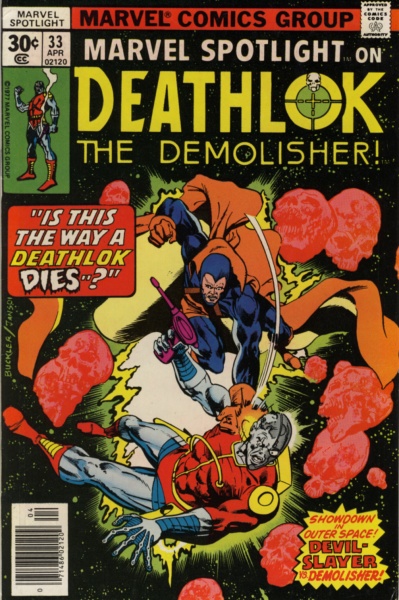
Eric Simon Payne thought he found purpose in life when he accepted an offer to join a mysterious cult and underwent an initiation to become a "reaper" … until discovering the cult's plan to call forth a long-dead race of demons, that is. Equipped with a magical sword and cloak, he took the name Devil-Slayer and eagerly set out to stop the forces of evil (Marvel Spotlight #33).
But for all his good intentions, Devil-Slayer had a hard time as a hero.
On his first adventure, Devil-Slayer picked a fight with Deathlok, mistaking the cybernetic crimefighter for a demon.
Ironically, in the recap of his origin story, Devil-Slayer thought that his own self-described "eerie sixth sense" was one of the reasons the demonic cult originally recruited him.
Marvel Spotlight. Vol. 1. No. 33. April 1977. "(Don't Fear) The Reaper!" [Dedicated with appreciation to the Blue Öyster Cult.] David Anthony Kraft (author), Rick Buckler, Mike Masser, Arvell Jones, Klaus Janson (artists), Howard Bender (letterer), Don Warfield (colorist), Beth Bleckley (computer type), Archie Goodwin (editor).
Interestingly, as noted above, credits for Deathlok's "computer type" thoughts were separate from the letterer credits. |  |
Thursday, November 10, 2011
Listening to the Lunatik
 Of all the opponents the Defenders faced, Lunatik was the most insufferable. As if being a serial killer wasn't bad enough, Lunatik persistently littered his speech with popular song lyrics and catch-phrases of the 1970s.
Growing up in that era, I got some satisfaction in recognizing when Lunatik was quoting the cuckoo bird from Cocoa Puffs or Mick Jagger from the Rolling Stones. But identifying the Lunatik's source material was no guarantee that he was making much sense. The Defenders, in fact, tried their hardest to tune him out.
Lunatik turned out to be not one man but several—each a splintered version of an extra-dimensional tyrant named Arisen Tyrk. The truth came out after drama professor Harrison Turk revealed that he too was one of the fragmented selves.
Reading between the lines, I now see the distracting use of quoted material in the Lunatik stories as an indirect indictment against popular culture.
The above image comes from Defenders #70, the issue when Professor Turk revealed he had a connection to Lunatik.
Thursday, September 15, 2011
Mutant Affairs
 During one of Beast's public lectures about his life as a superhero, Adrian Castorp, a musician who was persecuted for being a mutant, challenged the hero to take his role as a public figure more seriously. Instead of relying on humor, why didn't Beast discuss the discrimination mutants faced?
The message struck home, prompting Beast to found a movement advocating that mutants only need sensitivity, tolerance, and equal rights (New Defenders #142). As an homage to Adrian Castorp, who happened to have six fingers on each hand, the symbol for M.O.N.S.T.E.R. was a fist with six fingers (no connection to the Six-Fingered Hand).
Based on the letters column, reader response to the mutant storyline was favorable. The following letter on the topic appeared in #151.
- Dear Peter, Don, Kim, Janice, Michele, & Carl,
I'm writing to thank you for THE NEW DEFENDERS #142. I think this was the best of THE NEW DEFENDERS so far. I'm glad to finally see some intelligent Homo Sapiens in the Marvel Universe. Seeing people who accept mutants as people is an overwhelming joy. I thought this story was very touching.
I guess one of the reasons I liked this story so much was because of Adrian Castorp. He, like the first born male in my family, has six fingers on each hand. Just thought you'd like to know you really hit home with this one!
I guess this makes me a mutant too, huh? I wish you would consider making another character like him. You could even use my name!
Keep up the good work.
Bill Lawrence
Montclair, NJ
The above image comes from the New Defenders. Vol. 1. No. 142. April 1985. "M.O.N.S.T.E.R." Peter B. Gillis (writer), Don Perlin (penciler), Kim DeMulder (ink), Michele Wrightson (colorer), Janice Chiang (letterer), Carl Potts (editor), Jim Shooter (editor-in-chief).
Friday, April 15, 2011
Necessary Evil
 One of their most challenging sagas pit the Defenders against an alliance of evil demons calling themselves the Six-Fingered Hand.
Along with long-timers Dr. Strange, Valkyrie, and Hellcat, the Son of Satan and Gargoyle were principal members of the non-team at the time.
Given the group's open mind when it came to demon-heroes, Ghost Rider might have seemed like an obvious choice for membership. But Ghost Rider's brazen disposition made the Defenders think twice before seeking his help against just one member of the Six-Fingered Hand (Defenders #96). With Ghost Rider on their side, the Defenders defeated the demon Fashima, and a cult of followers led by rock singer Asmodeus Jones (no direct connection to the villain Asmodeus from Giant-Size Defenders #2).
Ghost Rider's alter ego, Johnny Blaze, returned for a guest appearance in Defenders #145. Ghost Rider later became a founding member of the Secret Defenders.
Defenders. Vol. 1. No. 96. July 1981. "The Rock and Roll Conspiracy!" J.M. DeMatteis (writer), Don Perlin and Joe Sinnot (artists), Diana Albers (letterer), George Roussos (colorist), Al Milgrom (editor), Jim Shooter (editor-in-chief).
Subscribe to:
Posts (Atom)


 Posts
Posts


