Dedicated to the definitive superhero non-team.


Showing posts with label RPG. Show all posts

Sunday, March 29, 2026

Realms of Magic

The Realms of Magic supplement for the Marvel Super Heroes role-playing game included a section on Magic Schools, more or less adhering to the three alignments popularized in early editions of Dungeons & Dragons: white magic = good; gray magic = neutral; black magic = chaotic/evil. A character could learn a particular school of magic yet violate those teachings. This would account for the villain Druid (Strange Tales #144-145), who is decidedly evil even though Realms of Magic (and D&D) describes druidic magic as neutral. Voodoo, on the other hand, is a white magic that can be perverted into chaotic magic.

Tuesday, January 28, 2025

Namor the Barbarian

Several earlier posts have described members of the Defenders as character classes from Advanced Dungeons & Dragons. After giving the topic even more thought, I'd like to suggest that Sub-Mariner would be a fitting candidate for the Barbarian subclass introduced by Gary Gygax in Dragon Magazine #63 (July 1982). Originating from a remote area, Barbarians often fight without armor and have an aversion to magic. Additionally, Sub-Mariner's pointed ears and Atlantean background could make him a half-elf, specifically aquatic elf (even though these early rules state that only humans can be Barbarians).

Robert E. Howard deserves credit for creating Conan, the archetypical barbarian from sword & sorcery literature. Drawing inspiration from Howard's novels, Conan the Barbarian was a long-running Marvel title.

Tuesday, August 20, 2024

Neutral Evil: Mr. Rasputin

An early adversary of Dr. Strange was Mr. Rasputin, a magician who sought to use defensive secrets from two warring nations for his own personal gain. In combat against Dr. Strange, Mr. Rasputin proved to be the weaker magician. To gain the upper hand, Mr. Rasputin drew a pistol, an action Dr. Strange deemed as a sign of cowardice. Be that as it may, Mr. Rasputin's criminal pursuit of power—without regard to political alliance—would align with Neutral Evil in Advanced Dungeons & Dragons.

  Lawful Good    Neutral Good    Chaotic Good  
  Lawful Neutral    True Neutral    Chaotic Neutral  
  Lawful Evil    Neutral Evil    Chaotic Evil  
This image of Mr. Rasputin comes from Strange Tales #145, reprinted as a flashback in Giant-Size Defenders #1.

Tuesday, August 13, 2024

Chaotic Neutral: Bernard the Poet

The original X-Men frequented Coffee A Go-Go in Greenwich village. Entertainment at the coffee house regularly included readings from a beat poet named Bernard. Decidedly unconventional, Bernard and his fans would surely embrace the the Chaotic Neutral alignment from Advanced Dungeons & Dragons.

  Lawful Good    Neutral Good    Chaotic Good  
  Lawful Neutral    True Neutral    Chaotic Neutral  
  Lawful Evil    Neutral Evil    Chaotic Evil  
Bobby Drake (Iceman) and Hank McCoy (Beast) hear Bernard's poetry for the first time in X-Men #7 (Sept. 1964).

Saturday, May 11, 2024

Spellbook: Rope Trick

In one of his earliest adventures, Dr. Strange discussed the ancient Indian rope trick (Strange Tales #116). During the trick, a magician climbs to the top of a rope and vanishes. That description more or less matched the 2nd Level magic-user spell Rope Trick that would appear in Advanced Dungeons & Dragons. When the spell is cast, one end of a rope rises into the air. The upper end of the rope fastens in an extra-dimensional space. The spell caster and up to five others can climb to the top of the rope and disappear into safety. The spell also allows climbers to stop and reach a normal place if they do not climb all the way to the rope's upper end.

After describing the ancient trick, Dr. Strange uses a sash as a rope substitute to climb diagnally upward and rescue three prisoners in Strange Tales #116 (Jan. 1964).
.
 

Sunday, April 7, 2024

Lawful Good: Comics Code Authority

I started posting about Dungeons & Dragons alignments almost a decade ago, usually as a lens to discuss various characters or teams. Along the way, I have wondered how the Comics Code Authority would fit within the nine alignments. Introduced in 1954, the lengthy set of rules greatly limited the artwork and text within comic books—to the chagrin of many fans and creators. As contentious as the code may have been, the prohibitions against glorifying crime or depicting criminals in a positive light would most closely match the alignment of Lawful Good. The revised version of the code from 1971 loosened some of these restrictions, allowing more depth and mature themes. The end result was still Lawful Good but certainly a more nuanced version of that alignment.

I plan to continue posting about character alignments intermittently in the coming months.

  Lawful Good    Neutral Good    Chaotic Good  
  Lawful Neutral    True Neutral    Chaotic Neutral  
  Lawful Evil    Neutral Evil    Chaotic Evil  

Saturday, March 2, 2024

Day of the Druid

The druidic philosophy outlined in early versions of Dungeons & Dragons considered the moral opposites of Law and Chaos as balancing forces of nature. As such, the clerical subclass of Druid adhered to the alignment of Neutral, a worldview with no particular leanings toward good or evil.

About a decade before the creation of the game, Strange Tales #144-145 presented a vastly different take on druids. The leader of a hidden cult combined mystic rites and modern technology to summon the Egg of Satan—a thing of evil designed to seek out Col. Nick Fury and destroy him. Given their diabolical aims, these druids might be a better fit for Lawful Evil, the alignment closely associated with devils in Advanced Dungeons & Dragons.

The cover of Strange Tales #144 (May 1966) likened the mysticism of Dr. Strange to Nick Fury's nemesis in "The Day of the Druid!" Dr. Strange starred in a different story within the issue.

Friday, November 24, 2023

Arrows and Alignments

Robin Hood was an inspiration for many a comic book archer, such as Green Arrow, Hawkeye and Golden Archer. Given my many posts over the years about the alignment system from Advanced Dungeons & Dragons, I was curious how the game assessed this folk hero.

An article from Dragon #55 (Nov. 1981) described Robin Hood as Chaotic Good, citing his love of total freedom and his hatred of injustice. That wasn't the last word, however. An article from Dragon #63 (July 1982) noted that bandits in the tradition of Robin Hood have an alignment of Neutral Good. This inconsistent take on Robin Hood, or characters like him, shows the room for interpretation within the nine alignments from AD&D.

The story of Robin Hood appeared in Marvel Classics Comics #34 (Oct. 1978).

Friday, May 12, 2023

The Monastic Moondragon

With her mental discipline and open-hand fighting style, Moondragon more or less met the criteria for a Monk from Advanced Dungeons & Dragons. That particular character class was all the more fitting given that she was trained by monks on Saturn's moon Titan. Moondragon's abilities also included an array of psionics, which were available in AD&D to a small percentage of humans with exceptional intelligence, wisdom or charisma—regardless of character class.

This image of Moondragon comes from New Defenders #127 (Jan. 1984).

Thursday, May 11, 2023

An Advanced Assassin

The Defenders faced their share of serial killers, but one member of the non-team had the makings of an Assassin from Advanced Dungeons & Dragons. Positioned in the game as a Thief subclass, an Assassin could brandish any weapon and become a master of disguise. The stealthy hero Devil-Slayer fit that description. For a twist on the AD&D requirement that Assassins must be evil in alignment, Devil-Slayer renounced the demonic cult that furnished the magical Shadow Cloak accentuating his abilities.

This panel comes from Devil-Slayer's debut in Marvel Spotlight #33.

Friday, May 5, 2023

Spellbook: Hypnotism

Following a string of posts comparing the sorcery of Dr. Strange to Magic-User spells from Dungeons & Dragons, here is example featuring Dr. Druid. Originally introduced as Dr. Droom, one of the character's earliest abilities closely matched the 1st Level spell Hypnotism that would become available to Illusionists (a subclass of Magic-Users) in Advanced D&D. After falling under this spell, a hypnotized subject would become susceptible to a verbal suggestion of the spellcaster.

This panel of Dr. Druid hypnotizing the extraterrestrial Zamu comes from Weird Wonder Tales #20 (Jan. 1977), reprinting a Dr. Droom tale from Amazing Adventures #3 (Aug. 1961).

Saturday, April 29, 2023

Spellbook: Shield

During his early adventures, Dr. Strange began defending himself with a shield of mystic energy. The evocation closely resembled the 1st Level spell Shield that would appear in the rules for Dungeons & Dragons. Of course, not all spells wielded by Dr. Strange would have counterparts in D&D, but it is interesting taking note of the similarities that do occur.

This panel from Strange Tales #144 (May 1966) shows Dr. Strange mystically shielding himself from the magician Tazza.

Friday, April 28, 2023

Spellbook: Mirror Image

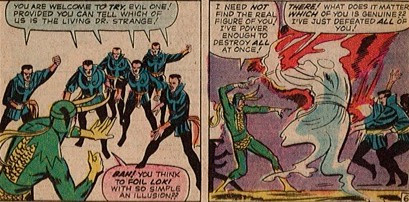
While dueling Loki in Strange Tales #123, Dr. Strange sought to fool his opponent by creating five illusionary images of himself. The magical effect closely paralleled the 2nd Level spell Mirror Image that would later appear in Dungeons & Dragons. One important distinction, however, was that Mirror Image could create only 1 to 4 illusionary selves. Loki countered by making all of the illusionary images of Dr. Strange disappear—casting the equivalent of Dispell Magic, the 3rd Level spell from D&D.

These panels first appeared in Strange Tales #123 (Aug. 1964).

Sunday, April 23, 2023

Spellbook: Levitate

Over the course of this blog, I've compared several members of the Defenders to early character classes or monsters from Dungeons & Dragons, describing Dr. Strange as a Magic-User. This is the first of several posts to compare some of the spells cast by Dr. Strange to spells that would become available to Magic-Users within the game.

Strange Tales #123 showed Dr. Strange practicing the art of levitation, which approximates the 2nd Level spell Levitate from early D&D rulebooks. This was not a spell that Dr. Strange would cast often, however, as he would soon obtain his signature Cloak of Levitation (#127).

This image first appeared in Strange Tales #123 (Aug. 1964).

Thursday, April 20, 2023

Chaotic Neutral: Man-Thing

A previous post on this blog compared Man-Thing to a Shambling Mound, a plant monster from Advanced Dungeons & Dragons. Under the game's nine-alignment system, a Shambling Mound was Neutral. But would that description hold true for Man-Thing?

A failed scientific experiment transformed Ted Sallis into the mammoth mound of vegetation known as Man-Thing. Although Sallis lost most of his intelligence as Man-Thing, he acquired a form of empathy that made him receptive to the emotions of others. Man-Thing's disposition could vacillate from curious to isolationistic, from tranquil to irate. Although he might accompany superheroes, this often resulted from happenstance. Given his capricious nature, Man-Thing might be better understood as Chaotic Neutral.

  Lawful Good    Neutral Good    Chaotic Good  
  Lawful Neutral    True Neutral    Chaotic Neutral  
  Lawful Evil    Neutral Evil    Chaotic Evil  
Man-Thing's original entry from The Official Handbook of the Marvel Universe appears below.

Saturday, June 4, 2022

Lawful vs. Chaotic

Having previously posted about the alignment system from Dungeons & Dragons, I wanted to explore how some editions of the game understood the terms Lawful and Chaotic as descriptors for civilization and unbridled nature. Following a reconnaissance mission in the Northwest Territories of Canada, the members of Alpha Flight illustrate these competing positions in a panel from Contest of Champions #1 (June 1982).

Here, Northstar mentions how he looks forward to returning to the city of Ottawa. Along these lines, Aurora remarks that she'd like to get back to teaching school in Quebec. In contrast, Sasquatch says he prefers the wilds. Snowbird says that is her element too.

Team leader Vindicator is unsurprised when Shaman interjects that there is much to recommend about both worlds. Within D&D, Shaman's sentiment reflects a Neutral alignment between the extremes of Law and Chaos.

Tuesday, May 24, 2022

Neutral Evil: Moondragon

Moondragon makes a compelling subject for the alignment system of Advanced Dungeons & Dragons. Originally introduced as Madame MacEvil (Iron Man #54), she soon joined the ranks of the Avengers as Moondragon. Even as a hero, though, Moondragon seemed driven to prove her own superiority above all else. For all her claims of transcending the mortal constraints of good and evil, Moondragon arrogantly followed a Neutral Evil alignent long before she joined the New Defenders as a villain under duress.

  Lawful Good    Neutral Good    Chaotic Good  
  Lawful Neutral    True Neutral    Chaotic Neutral  
  Lawful Evil    Neutral Evil    Chaotic Evil  
This image of Madame MacEvil comes from Iron Man #54. As Moondragon, the color of her costume changed to green.

Wednesday, March 23, 2022

Tigra's Tagline

Tigra effectively inherited her own series in Marvel Chillers #3-7 (Feb.-Oct. 1976), when she received cover billing as Tigra, the Were-Woman. Perhaps because she gained her powers through scientific means and not lycanthropy, the character received a new tagline in Marvel Premiere #42 (June 1978), headlining instead as as Tigra, the Feline Fury.

For curiosity's sake, I decided to see what Advanced Dungeons & Dragons had to say about weretigers at this time. In keeping with Tigra, the Lycanthrope entry in the Monster Manual described weretigers as most often female and very rare to encounter. Werewolves, on the other hand, were relatively common by comparison.


Saturday, February 27, 2021

Monstrous Alignments

The Defenders encountered their share of monsters. As such, recent posts about the alignment system from Dungeons & Dragons prompted me to look up the alignment of various creatures as described during the formative years of the game. In doing so, I consulted a softcover introductory rulebook for D&D (1974) and the hardcover Monster Manual (1977) for Advanced Dungeons & Dragons.

Although there was general agreement between the two publications, I was surprised to see different alignments listed for several monsters. With Aragorn in mind, I saw in the introductory rulebook that Pegasi were Lawful Good and served only Lawful Good characters. Meanwhile, the Monster Manual entry for Pegasus listed the winged horses as Chaotic Good and willing to serve characters of any good alignment.

While reflecting on Dracula, I found another example of varying interpretations of alignment. The Vampire entry from the introductory rules listed Lawful Evil as the monster's alignment while the corresponding Monster Manual entry began, "The most dreaded of the chaotic evil undead is the night-prowling vampire." These different perspectives about certain monsters showed the subjective nature of the alignment system, especially when describing those with nuanced or complex behavior. I imagine that I'll revisit the topic of alignment again with respect to the Defenders.

Friday, February 5, 2021

Lawful Good: Tom Thumb

Tom Thumb, resident inventor of the Squadron Supreme, played a pivotal role in bringing forth the Utopia Program on the Squadron's homeworld. Tom's most notable invention was a behavior modification machine designed to rehabilitate criminals by conditioning them to detest illegal thoughts … essentially compelling them to act in accordance of the Lawful Good alignment from Dungeons & Dragons. The behavior modification machine, along with other aspects of the Utopia Program, invited criticism for encroaching on civil liberties.

After developing cancer, Tom Thumb traveled to the 40th century to steal a Panacea Potion from the Scarlet Centurion, only to find upon returning home that the fabled cure was nothing more than penicillin and a few complex vitamins. Before his death, the conflicted hero regretted compromising his principles out of desperation (Squadron Supreme #9). Tom Thumb was an example of a character who extolled the virtues of Lawful Good despite deviating from that alignment.

  Lawful Good    Neutral Good    Chaotic Good  
  Lawful Neutral    True Neutral    Chaotic Neutral  
  Lawful Evil    Neutral Evil    Chaotic Evil  
This panel from Squadron Supreme #10 recalls when Tom Thumb joined the team. On a surface level, Tom Thumb's below-average height was reminiscent of the DC hero Atom (as the Squadron was an homage to the Justice League of America). Unlike Atom, however, Tom Thumb did not have the power to change size. Rather, Tom Thumb's aptitude as an inventor earned him a unique place in the Squadron.